Manufacturer data sheets show absorption under ideal conditions, not inside your enclosure. You can choose the right acoustic material by physically quantifying layer thickness, flow resistance, and cavity depth. ASCEE measures the impedance in the lab and simulates the behavior in COMSOL. This allows you to select the right material for your design in advance.
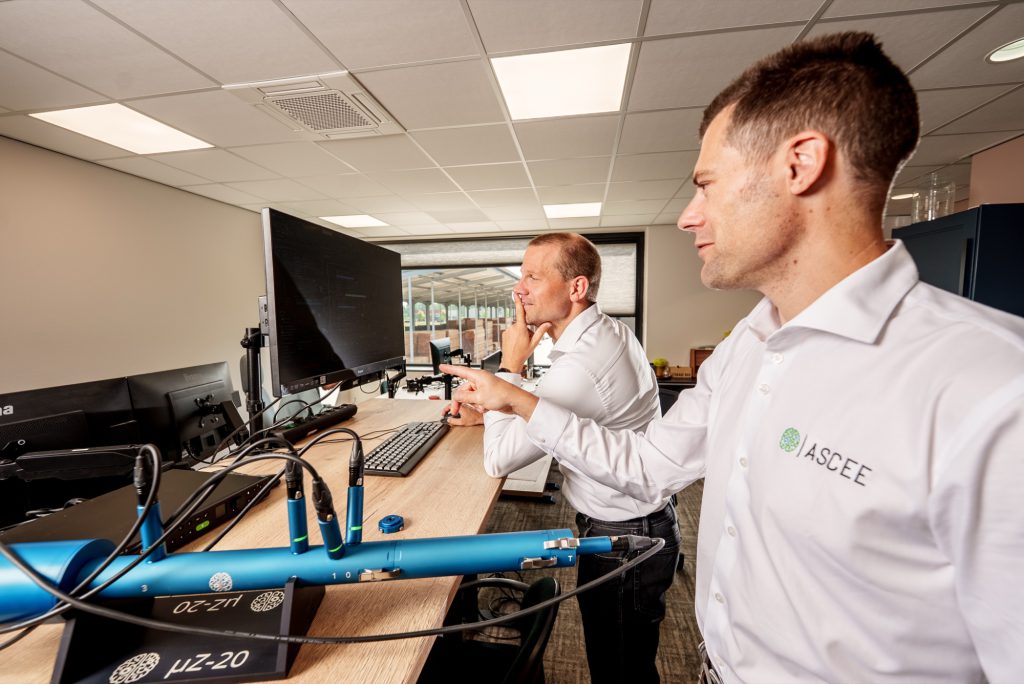
To determine which material is suitable, its frequency-dependent behavior must be known. In our laboratory in Nijverdal, we use our in-house µZ impedance tube (20 and 30 mm) to measure the normal sound absorption coefficient ($\alpha$), the reflection coefficient ($R$), and the normalized acoustic impedance ($\zeta_n$) from 20 Hz to 8 kHz. For acoustic meshes and membranes in compact electronics, we quantify the acoustic series impedance and flow resistance. This allows us to precisely determine the trade-off between protection against dust and water (IP rating) and acoustic transparency.
A measured absorption graph cannot be imported directly into a 3D CAD program. To predict how a foam or porous absorber will behave in a different shape or thickness, we fit the measurement data to physical material models:
These parameters serve as the numerical input for simulations.
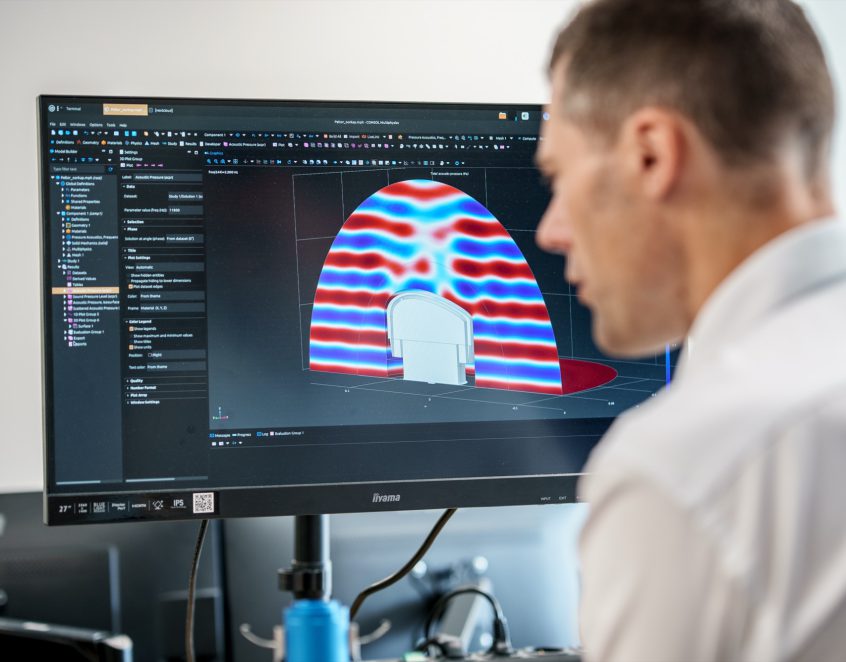
As a COMSOL Certified Consultant, we model the interaction between acoustic waves, mechanical structures, and material behavior. We integrate DBM and JCA material parameters directly into a FEM model of your 3D design to predict damping and resonances.
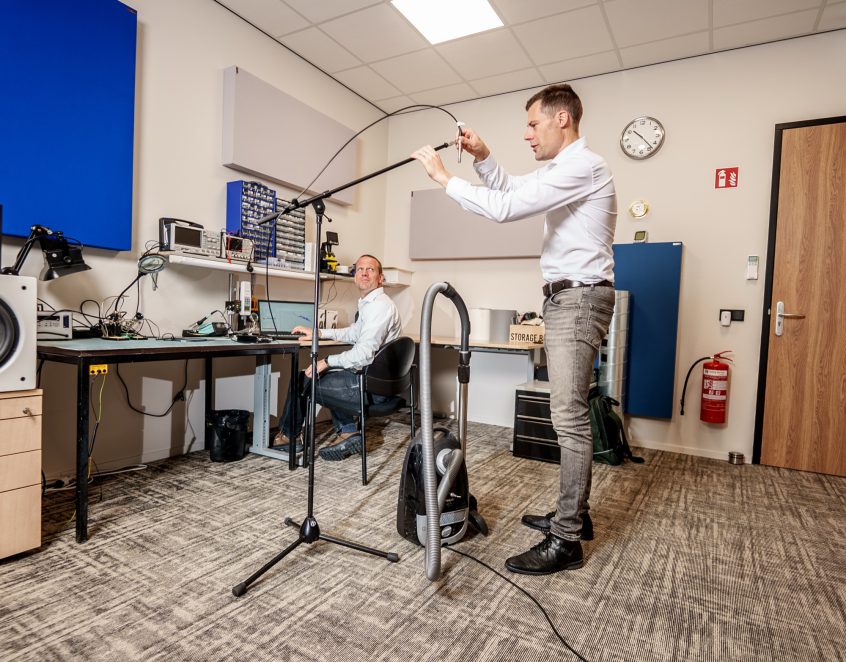
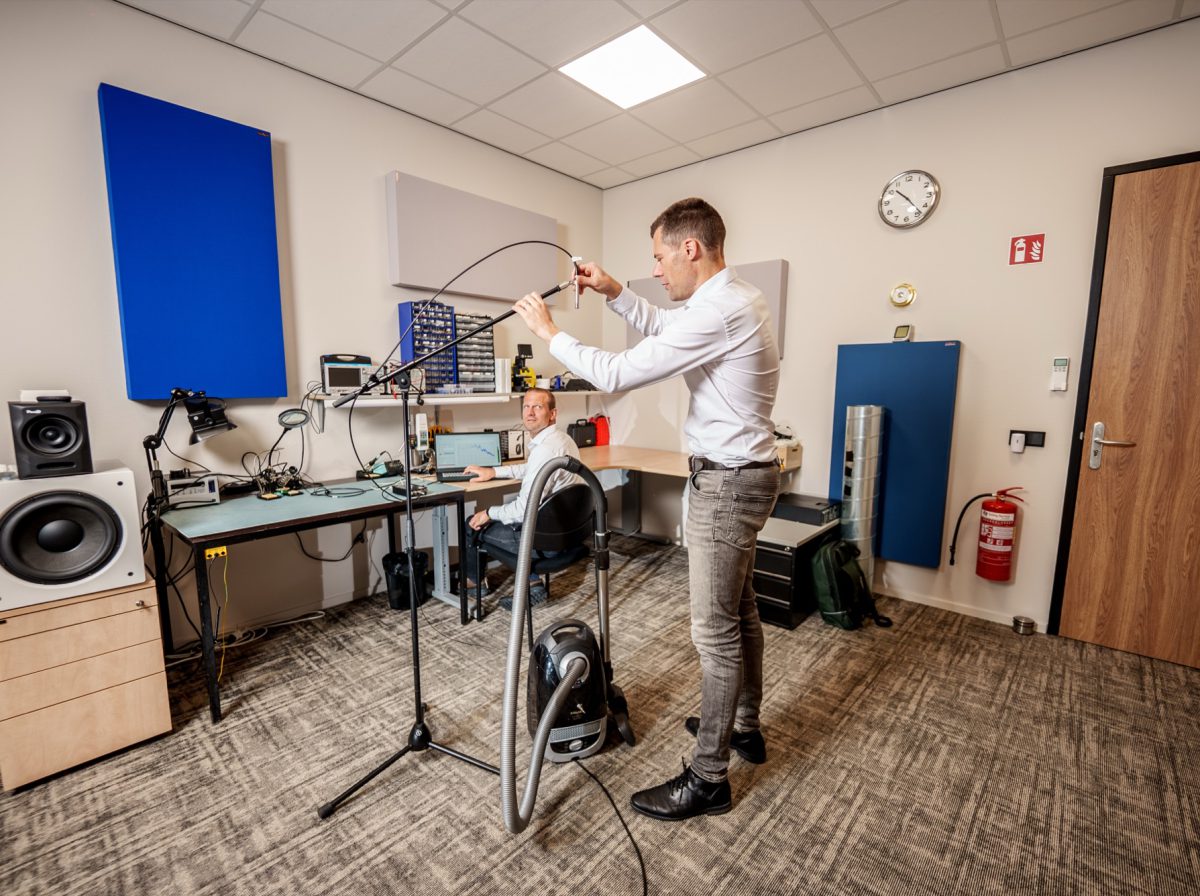
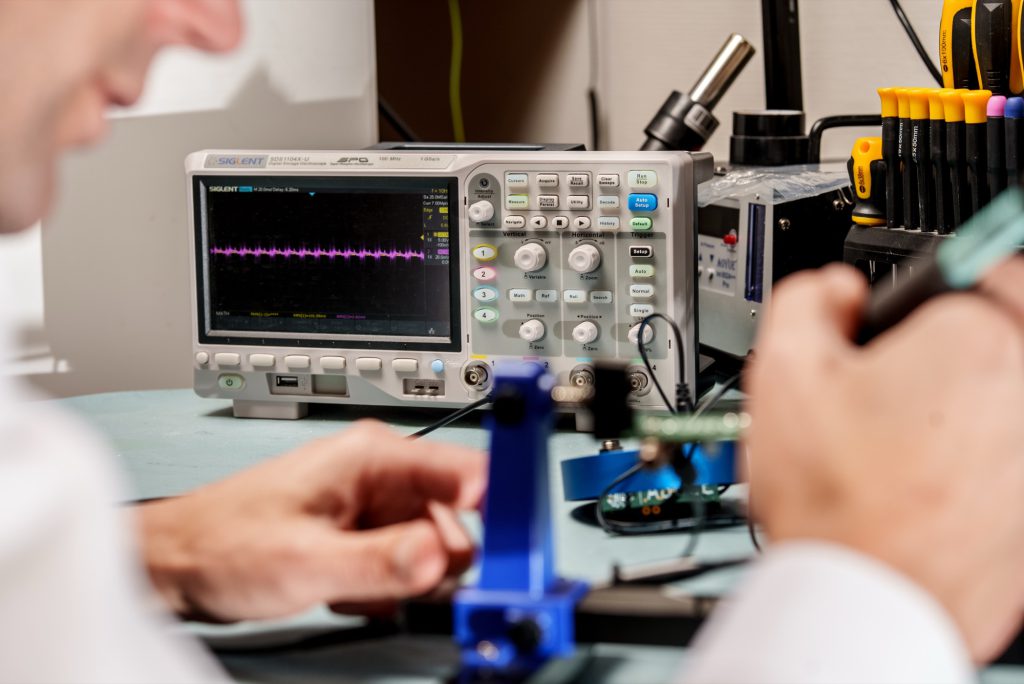
Our laboratory is a 60 m² acoustically anechoic chamber equipped with multiple µZ impedance tubes, measurement microphones, ultrasonic microphones, data acquisition equipment, an audio analyzer, and signal generators. Here, we perform ISO 10534-2 impedance measurements, sound power measurements, and IEC 60318-4 ear simulator tests.
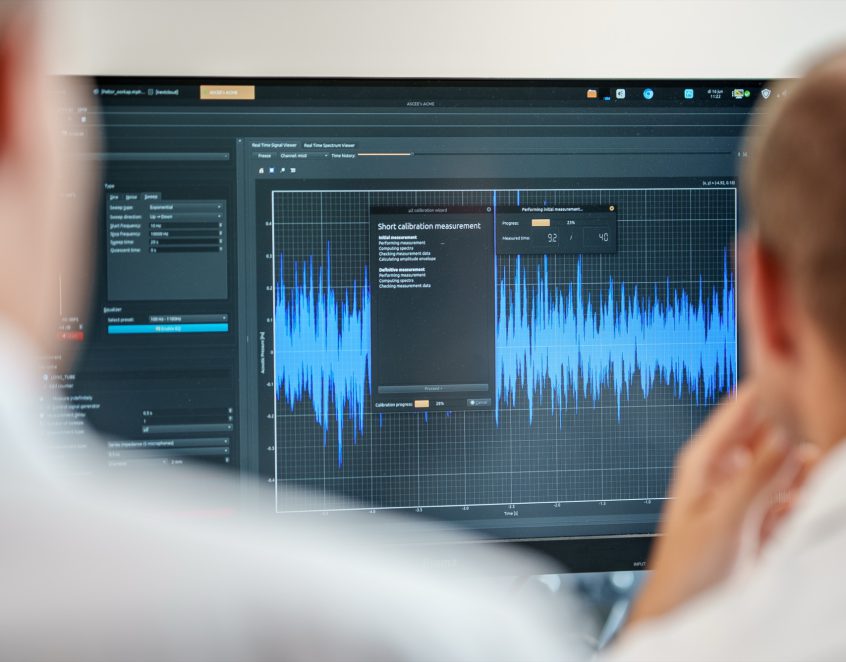
Using our proprietary ACME software, we automate data acquisition (DT9837A), sensor calibration, and real-time frequency analysis. With LRFTubes, we calculate 1D wave propagation and attenuation in channels using fast lumped-element models.

