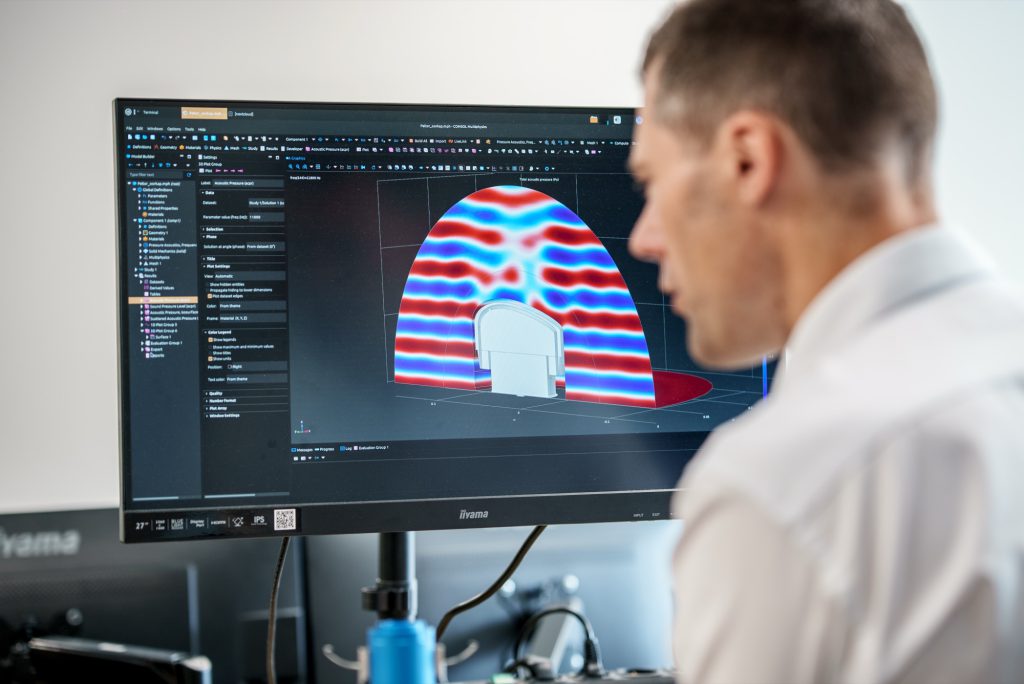
Predicting mechanical and acoustic product behavior helps prevent failure costs during prototyping. ASCEE assesses design risks using acoustic simulations through Computer-Aided Engineering (CAE). As a COMSOL Certified Consultant, we analyze the interaction between acoustics, fluid dynamics, and structural mechanics. This allows us to optimize the design prior to the first production run.
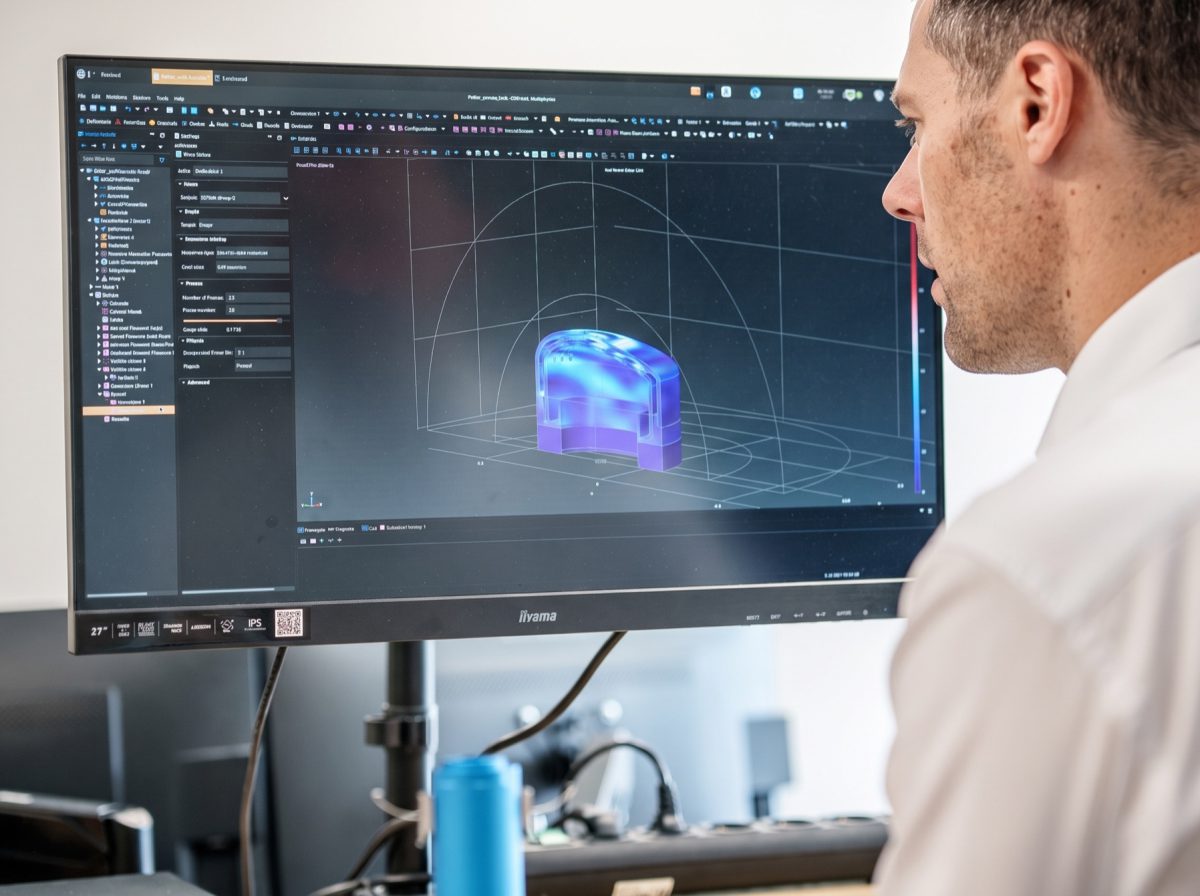

We couple electrostatics, mechanics, flow, and contact in COMSOL to calculate the overall system behavior.

Calculate gas bearing pressures in pistons and squeeze-film damping in MEMS devices through a numerical solution of the Reynolds equation.
In narrow channels, thermal and viscous boundary layer losses determine the acoustic response. We model this attenuation.
We replace FE domains with derived formulas. This reduces computation time from days to minutes without any loss of data.
As certified consultants, we build and validate simulation models directly within your team’s R&D process.
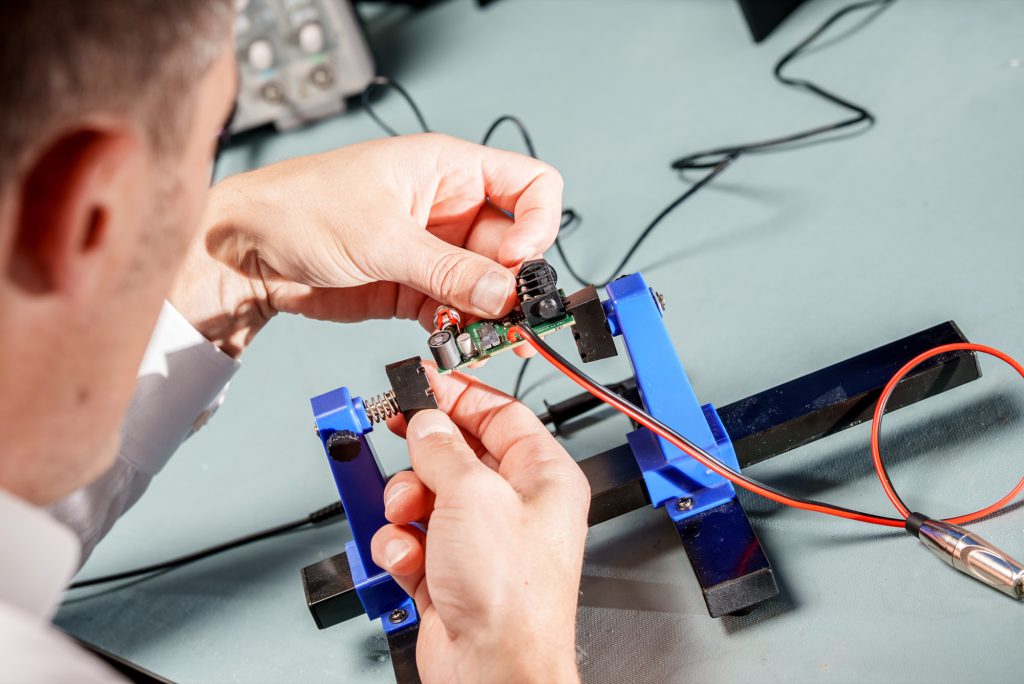
By numerically determining resonances and impedances in advance, you can avoid having to redesign the circuit and reduce testing time in the lab.
In MEMS transducers and microspeakers, physical domains directly influence one another. Electrostatic forces deform the diaphragm, while the compressed air layer provides squeeze-film damping. At maximum excursion, contact mechanics dampens the motion. Because forces, gap size, and deformation are coupled, ASCEE calculates these simultaneously in a single model: electrostatics, structural mechanics, fluid dynamics via the Reynolds equation, and contact mechanics. This provides a reliable prediction of the actual behavior.